A complete school quality system that digitises the official SQAAF framework — from guided self-assessment and evidence collection to improvement planning and SSSA assurance. 5 domains, 53 sub-domains, 1,047 quality points, scored across three growth tiers.
For decades, school evaluation in India has been fragmented and compliance-led — incomparable across boards, one-time rather than continuous, and disconnected from real improvement. SQAAF, NCERT's School Quality Assessment & Assurance Framework, was created to fix exactly this.
State boards, CBSE, ICSE and international boards have long used incompatible quality benchmarks — making equitable, like-for-like school evaluation impossible across India.
Existing audits test for minimum standards as a one-time event, rather than evolving practice. There is no growth-oriented model that shows a school how to get better.
Even where assessments exist, schools struggle to turn findings into concrete next steps — and there's no transparent, verifiable record for the state authority or community.
SQAAF implements each of the five quality domains from NCERT's official framework, turning the printed checklist into a guided, evidence-backed, automatically-scored digital workflow.
The framework evaluates governance, leadership, financial stewardship, staffing, safety and stakeholder engagement — 8 sub-domains, 56 indicators.
The largest domain — how effectively learning is designed: NEP-aligned, skill-based, multilingual, future-ready — 17 sub-domains, 118 indicators.
Competency-based, continuous evaluation — Holistic Progress Cards, exam integrity, and PARAKH equivalence — 11 sub-domains, 60 indicators.
Quality, accessibility and sustainability of physical and digital resources — 9 sub-domains, 51 indicators.
The cornerstone — equity, diversity and socio-economic support so every learner belongs — 8 sub-domains, 64 indicators.
Every indicator is rated against three growth tiers — drawn from the Sanskrit lexicon of progress — capturing not just where a school stands today, but where it is headed next. Each carries 1, 2 or 3 points.
The foundational stage. Schools show limited alignment with benchmarks and significant gaps in planning, resources and execution.
Schools meet most standards with clear scope to reach excellence — functional but with room to scale and innovate.
Excellence. Schools consistently meet or exceed benchmarks and are recognised as model institutions for others to follow.
From guided self-assessment to a verifiable evidence locker, an auto-generated improvement plan, and transparent public disclosure — each feature maps directly to the SQAAF framework.
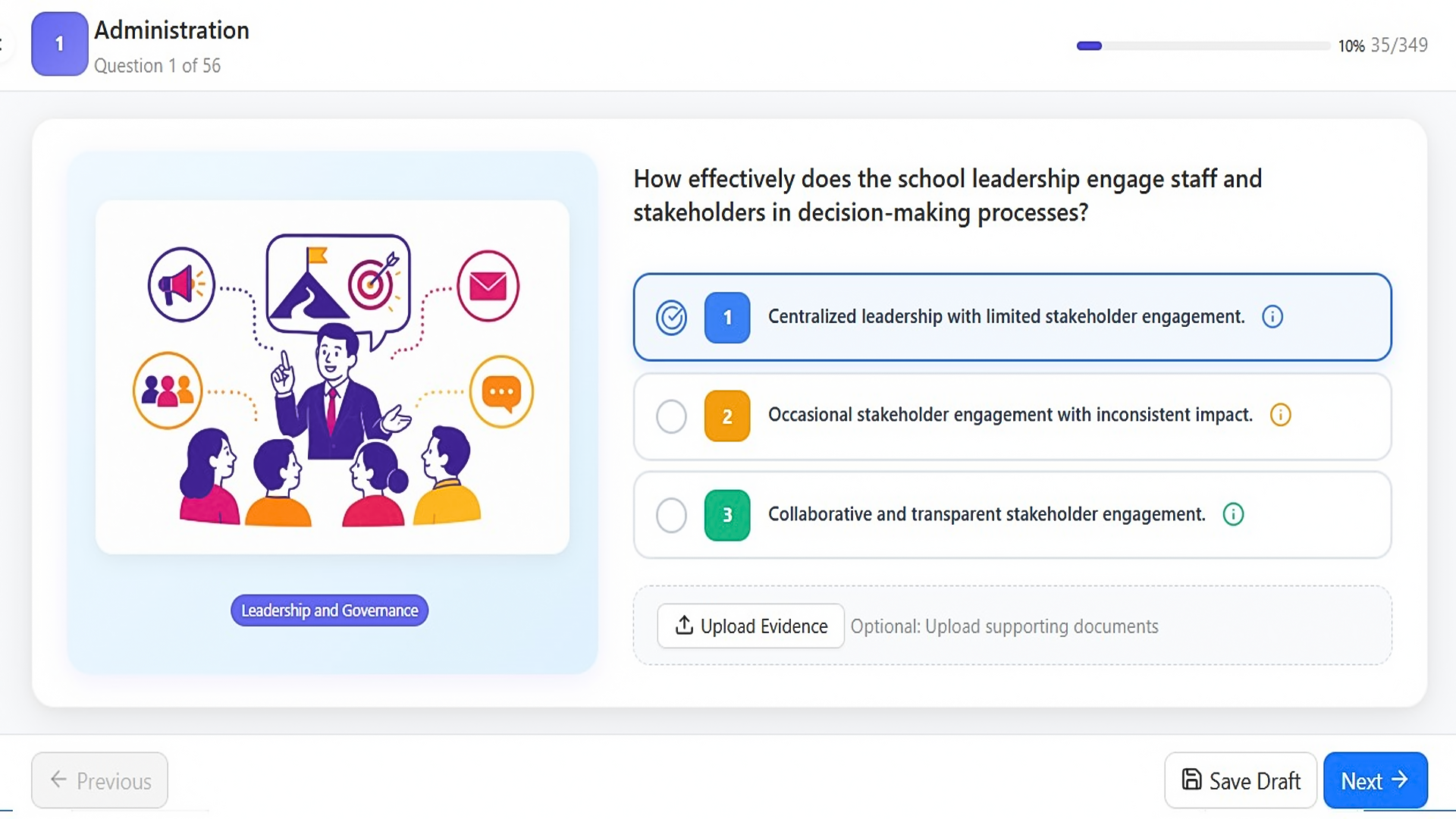
All 349 indicators across five domains, presented one at a time with the three benchmark descriptors. Live scoring, auto-save and per-domain progress tracking.
Attach documents against any indicator — improvement plans, audit reports, policies, photos. A structured, versioned portfolio that substantiates every rating.
On submission, SQAAF auto-generates a domain-wise breakdown, determines the band, and surfaces the lowest-scoring sub-domains for action.
Turns findings into a roadmap. Auto-suggests framework-aligned interventions per tier — Abhilasha, Pragati & Jagriti — with timelines and owners.
State School Standard Setting Authority workflow — review submissions, validate evidence, accredit and monitor compliance with full audit trails.
Publishes assurance status and quality outcomes to the State Vidya Samiksha Kendra portal — building community trust and accountability.
A working preview of the school-facing platform — built on the real framework. Click through the tabs and try the controls: rate an indicator, watch the score move, attach evidence, and see the improvement plan write itself.
Select a domain below — the system surfaces tier-appropriate interventions drawn from the official SQAAF Post-Assessment Intervention Library, each with an owner and a timeline.
SQAAF is not a one-time audit. It is a continuous improvement cycle — each step feeding the next, each cycle raising the baseline for the one that follows.
Rate all 349 indicators across the five domains with evidence and stakeholder input.
Auto-generated dashboard reveals strengths and the lowest-scoring sub-domains.
Build a School Quality Improvement Plan with framework-aligned actions & owners.
SSSA reviews evidence, validates the rating and grants assurance status.
Reassess next cycle, benchmark against peers and evidence continuous growth.
Schedule a live walkthrough of SQAAF with your team. We'll show you how the system maps to your State, SSSA and schools' specific needs.
The School Quality Assessment and Assurance Framework is a comprehensive resource designed to address the pressing need for standardised and equitable quality practices across schools in India. Through five domains and a strong emphasis on fairness, inclusivity and continuous improvement, it equips educators, administrators and policymakers to transform schools and pave the way for a future-ready education system aligned with NEP 2020.
This is a framework showcase. Submissions here are illustrative only.